

More than knee pain.
Before we talk about joints and treatments, I want to talk about you. If knee pain is changing how you walk, work, sleep, or spend time with family, I know you are looking for more than another explanation of arthritis. You want to know whether life can feel easier again.
The little things can become big things
A flight of stairs. Getting out of a chair. Walking through the grocery store. Things you once did without thinking can begin to take planning. You may find yourself turning down activities, looking for somewhere to sit, or wondering how your knee will feel tomorrow.
The worry deserves attention, too
Perhaps you have been told you are “bone on bone.” Maybe you worry about surgery, losing your independence, or giving up something you love. Those concerns matter. I want to hear what this has been like for you, and what you most want to get back to doing.
There is a reason to explore your options
Many people with knee osteoarthritis can improve pain and daily function with appropriate nonsurgical care. [2,5] Your starting point and goals are your own. We begin by understanding your knee, discussing suitable options, and building a plan around meaningful progress.
My goal is simple: help you understand your options and work toward more of the life you miss.
Dr. Christopher T. Cordima
What does “bone on bone” actually mean?
Smooth cartilage covers the knee joint surfaces; menisci cushion the joint and joint fluid reduces friction. In advanced osteoarthritis, cartilage loss can leave very little joint space, sometimes described as “bone on bone.” It describes structural change, not a complete treatment plan. [2]
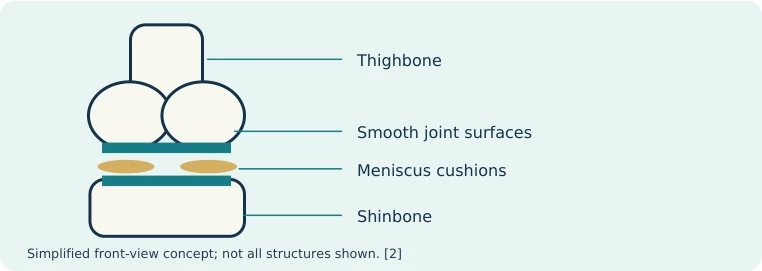
Thighbone
Smooth joint surfaces
Meniscus cushions
Shinbone
Simplified front-view concept; not all structures shown. [2]
Hearing “bone on bone” can feel like a verdict. Yet an evaluation should also consider your pain, strength, movement, and daily function. Symptoms and how life is affected help guide decisions about care, including a surgical opinion. [2,5]
Strengthening the surrounding muscles can help support the knee. Symptom and function goals are different from regrowing cartilage. Our program does not promise cartilage replacement or a way to avoid needed surgery. [3]
Ask: Which findings explain my symptoms, and what can we reasonably work on?
Do not let your routine quietly shrink
If knee pain keeps narrowing your life, it is worth taking seriously. What began as skipping a long walk may become avoiding everyday errands. You do not need to wait until your knee controls your schedule to ask for help.
For knee osteoarthritis, avoiding movement altogether can contribute to muscle weakness and stiffness. Appropriately chosen exercise is an important part of care. This does not mean pushing through an injury or ignoring severe pain. [3,4]
“Bone on bone” does not, by itself, answer every question about your next step. Osteoarthritis does not necessarily worsen in every person. Whether to consider surgery depends on symptoms, daily limitations, and response to suitable nonsurgical care. [4,5]
Get prompt medical advice [1] Seek urgent assessment for severe pain, inability to bear weight, major swelling, deformity, locking, or giving way. A hot, red knee with fever may signal infection.
Until you have a plan
- Notice which activities trigger symptoms and how long they last.
- Avoid repeatedly forcing a movement that causes severe pain.
- Ask which activities are appropriate for your knee right now.
Getting answers is a practical way to protect your options. It is not a commitment to any particular treatment.
Knee pain can have more than one cause.
Where it hurts, how it began, and what makes it better or worse all help guide your evaluation. Osteoarthritis is common, but it is only one possible explanation. [1,2]
Osteoarthritis
Changes in cartilage and other joint tissues can bring aching, stiffness, swelling, and difficulty with everyday movement. Your symptoms and function matter alongside any imaging findings. [2]
Meniscus or ligament injuries
A twist or injury may affect the knee’s cushions or stabilizing ligaments. Catching, locking, swelling, or giving way deserve assessment so the next step matches the injury. [1]
Tendon or bursa irritation
Repetitive loading can irritate tendons, while an inflamed bursa can make kneeling or bending uncomfortable. The location and pattern of pain help distinguish these problems. [1]
Start with the right questions
Is this a joint problem, a soft-tissue problem, or something that needs further medical assessment? An examination helps us decide whether care in our office fits your needs.
A plan built around your knee and your goals
We select care around your examination, health history, comfort, and the activities you want back. Each part of your plan has a purpose.
Knee On Trac knee decompression
This device applies controlled mechanical traction across the knee. We may use it with the aim of easing joint discomfort and helping movement feel more comfortable. Suitability and settings depend on your findings and tolerance. [6]
Red light and other light therapies
We use red light, infrared, cold laser, and Class 4 laser as appropriate for your needs. Our goal is to ease discomfort and support comfortable activity.
Electrical stimulation / neuromodulation
Neuromodulation uses targeted electrical signals to influence nerve activity. Nerve and muscle stimulation may be selected with the goals of easing painful signaling and encouraging muscle activity. We explain the purpose of any recommended stimulation before starting.
Therapeutic exercise
Strengthening and appropriate aerobic activity help build the capacity you need for walking, stairs, and everyday tasks. We choose and progress exercises according to your ability, symptoms, and goals. [3,5]
Start with your story. Build a practical plan.
Tell us what your knee is keeping you from doing. A useful evaluation connects your symptoms and examination findings with your daily life.
1 Tell us what has changed
We discuss when symptoms began, injuries, swelling, stiffness, and the activities that are difficult. We also review previous care, relevant health conditions, and medicines.
2 Understand the findings
Your evaluation may include knee movement, strength, walking, and other relevant examination findings. Bring any existing imaging reports. We discuss whether additional imaging or a specialist assessment would help.
3 Discuss your options
If care here is appropriate, we explain the recommended treatments, their purpose, expected visit schedule, costs, and when progress will be reviewed. Your plan is individualized rather than based on a fixed number of visits for everyone.
4 Choose goals you can recognize
A meaningful goal might be walking around the block, using stairs more comfortably, or standing long enough to prepare a meal. We use your goals alongside symptoms and examination findings to review progress.
Answers before you begin
Can you help if I have been told “bone on bone”?
An evaluation helps determine whether nonsurgical care fits. Decisions depend on symptoms, daily function, health history, and previous care. [2,5]
Will my insurance cover this?
Some insurance plans cover chiropractic adjustments to the extremities. Medicare does not. [10] In our office, Knee On Trac traction, light therapy, custom orthotics, and supplements are self-pay and will not be billed to insurance. We explain fees before care begins.
Is this guaranteed to work?
Nothing in healthcare is guaranteed. For a suitable candidate, following an individualized program offers an opportunity for meaningful relief and better daily function. We set clear goals and review your progress along the way.
How many visits will I need, and what does it cost?
We discuss your proposed schedule, fees, and progress reviews after your evaluation.
What can I do between visits?
Follow your activity and exercise guidance. Ask which movements suit your knee, and tell us about changes in symptoms. [3,5]
What if I have already tried other treatments?
Tell us what helped and what did not. This helps us discuss your next step, including a medical or surgical opinion when appropriate. [5]
What is possible for you?
A plan, not a magic bullet
There is no single answer for every knee. We start by understanding your needs, then choose care with clear goals: comfort, movement, strength, and the activities you miss.
Can you be helped?
Your history, examination, and previous care help us decide whether our approach fits. A diagnosis or the number of years you have had pain does not answer that question by itself.
You deserve an honest conversation
I will explain what we recommend, why, and how we will review your progress. If testing or another type of care makes more sense, I will explain that, too. Tell me about any concerns that could make following a plan difficult.
Small wins can make a real difference
Walking farther. Taking the stairs more comfortably. Standing long enough to cook dinner. These are meaningful goals. We will look at changes in your symptoms and daily function together, rather than promise the same result to everyone.
Schedule a Knee Evaluation
Call (617) 629-2600
About Dr. Cordima

Dr. Christopher T. Cordima, DC, BCN Practicing since 1988.
Board Certified in Chronic Intractable Pain & Neuropathy.
Dr. Cordima graduated from Palmer Chiropractic College in 1987 and received his chiropractic license in November 1988. He comes from a family with a legacy in chiropractic care and is proud to carry that tradition forward.
His approach starts with listening: what hurts, what you have tried, and what you want to get back to doing. He is dedicated to compassionate, honest care and helping you understand whether a natural, nonsurgical approach fits your needs.
Outside the office, he enjoys time with his loving partner, Linda, and their family, hiking New England trails with Benny, exploring local coffee shops and restaurants, and cooking together.
Let's talk about getting you back to the life you miss.
Cordima Chiropractic Center Call (617) 629-2600 to schedule an appointment.
Visit somervillechiropractor.com
References
1. National Health Service. Knee pain. Read source
2. American Academy of Orthopaedic Surgeons. Arthritis of the knee. OrthoInfo. Read source
3. American Academy of Orthopaedic Surgeons. Knee exercises. OrthoInfo. Read source
4. National Health Service. Osteoarthritis: treatment and support. Read source
5. NICE. Osteoarthritis in over 16s: diagnosis and management. NG226. Recommendations. Read source
6. Ergo-Flex Technologies. Knee On Trac: how it works. Manufacturer device description. Read source
7. Florjančič K, Vauhnik R. Effects of standard physiotherapy with the addition of mechanical traction on pain, physical activity and quality of life in patients with knee osteoarthritis. Medicina. 2025;61(3):507. Read source
8. Stausholm MB, et al. Efficacy of low-level laser therapy on pain and disability in knee osteoarthritis: systematic review and meta-analysis of randomised placebo-controlled trials. BMJ Open. 2019;9:e031142. Read source
9. Photobiomodulation does not provide incremental benefits to patients with knee osteoarthritis who receive a strengthening exercises program: a randomized controlled trial. Brazilian Journal of Physical Therapy. 2023;27(4):100519. Read source
10. Centers for Medicare & Medicaid Services. Chiropractic services: coverage limited to manual spinal manipulation. Read source
Understanding the evidence
Exercise is a core part of osteoarthritis care. Evidence for additional devices and light therapies varies; NICE does not recommend laser or several electrical therapies for osteoarthritis because evidence of benefit is insufficient. Studies of specific lasers or traction methods do not establish the effectiveness of our combined program. [5,7–9]
Office descriptions reflect information supplied by Dr. Cordima. The goal is comfort and function, not a promise of cartilage regrowth or avoidance of needed surgery. This guide is educational; recommendations follow an individual evaluation. Illustrations are educational or lifestyle artwork, not patient testimonials.
Keep a copy of this guide
Save the PDF to read later or bring it to your appointment.
Download PDFLearn about knee decompression or explore all services at our office. Your evaluation guides which options may be appropriate.