
When every step asks too much.
Before we talk about the bottom of your foot, I want to talk about what this pain may be taking from your day. Getting out of bed. Standing long enough to make dinner. Walking the dog. These should be ordinary moments, yet heel pain can make you hesitate before each one.
FIRST STEPS
A sharp ache after sleep or sitting
TIME ON YOUR FEET
Standing or walking becomes difficult
You may worry about keeping up at work, getting back to exercise, or having to give up an outing with family. If you have already tried different shoes or inserts, it is understandable to feel frustrated. I want to hear what you have tried and what you miss doing.
First-step heel pain is a common plantar fasciitis pattern. It may ease as you move, then return with longer periods on your feet. An examination helps us understand whether that is what you are dealing with. [1,2]
There is room for hope.
Nonsurgical care can help many people with plantar heel pain. Our goal is to make walking more comfortable and help you return to the parts of life you enjoy. [3,5]
A support band under your foot
The plantar fascia is a strong band of connective tissue along the sole, linking the heel to the front of the foot and supporting the arch. It handles stress as you stand and walk. Irritation or tissue changes can produce pain near its heel attachment. [3]
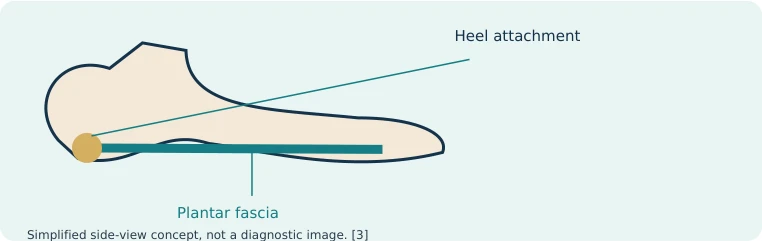
Contributing factors may include changes in activity, repeated standing on hard surfaces, tight calf muscles, and foot shape. It is not always possible to identify one single cause. [3]
What about a heel spur? A spur can be seen in people without heel pain. Finding one on an X-ray does not, by itself, mean it is the cause or that it needs removing. [4]
Think beyond the sore spot. An evaluation can consider ankle movement, calf flexibility, foot loading, footwear, and daily demands.
Let’s understand your foot.
You do not need to know the diagnosis before you call. Start with your story: where it hurts, when it began, and what your foot lets you do comfortably.
YOUR HISTORY
We ask about first-step pain, standing and walking, recent activity changes, footwear, previous injuries, and treatments. Tell us about diabetes, numbness, or other health concerns. [1,2,6]
YOUR EXAMINATION
We check the painful area, foot and ankle movement, calf flexibility, and other findings that help explain your symptoms. Nerve-related signs or an unusual pain pattern may call for a different approach. [2,5,6]
YOUR NEXT STEP
We explain what we found, whether care here fits, and what each recommendation is meant to help. Imaging or another clinician may be needed when the findings suggest another cause. [2,3]
Bring your usual shoes, medication list, and any relevant imaging reports. We want a plan that works with your daily life.
Several tools. One personal plan.
A sore heel can need more than one kind of support. We choose care around your examination, comfort, and goals, then review how you are responding.
Soft tissue and joint care
Hands-on techniques may address tenderness and movement restrictions in the foot, ankle, or calf. We use them with the aim of easing discomfort and improving movement alongside your exercises. [5]
Stretching and strengthening
Plantar fascia and calf stretches help with flexibility. Gradually building foot and ankle strength can help you handle everyday demands. We choose the starting point and progression around your tolerance. [5,7,8]
Footwear, taping, and orthotics
Comfortable, supportive footwear and selected taping or inserts may help manage stress on a painful foot. Custom orthotics may be considered when appropriate. Support works best as part of a broader plan that also includes movement and exercise. [5,6]
Red light and other light therapies
We use red light, infrared, cold laser, and Class 4 laser in the office as appropriate for your needs. The goal is to ease discomfort and support comfortable activity. Laser therapy has been studied for plantar heel pain. [5,12]
Home care and progress reviews
We discuss what to do between visits and track meaningful changes: morning pain, time on your feet, and the activities that are becoming easier.
Make the plan fit your day.
Small, steady changes are often easier to follow than a complete overhaul of your routine. We can help you decide where to start.
GIVE YOUR FOOT A MANAGEABLE WORKLOAD
Break up long stretches of standing or walking when possible. Ask which activities you can keep doing and which need a temporary change. Swimming may be an option when appropriate. [1,6]
CHOOSE COMFORTABLE SUPPORT
Look at the shoes you wear most, including at home. Cushioned heels and comfortable arch support may help. Avoid barefoot walking on hard floors if it aggravates your symptoms. [1]
FOLLOW YOUR EXERCISE GUIDANCE
Gentle stretching and progressive strength work should match your needs. Ask us to check your technique. Let us know if an exercise causes a marked flare so we can adjust it. [5,7,8]
NOTICE THE SMALL WINS
Are those first steps easier? Can you stand longer to cook? Are you less sore after a walk? Bring those changes to your progress review.
You do not have to guess your way through recovery. Ask questions as you go.
A hopeful path back to walking.
How long does it take to get better?
Some people improve over a few weeks; others need several months or longer. How long you have had symptoms, your daily demands, and your response to care all matter. Cleveland Clinic describes healing over a few weeks to a few months. [11]
What does the research show?
A trial of people with chronic heel pain found better first-step and worst-pain scores with plantar fascia-specific stretching than calf stretching at eight weeks. [7]
In another small trial, progressive strengthening plus inserts improved pain-and-function scores more than stretching plus inserts at three months. The groups did not differ at six or twelve months. [8]
What if it has been bothering me for a long time?
Long-standing pain still deserves attention. Stretching research found lasting improvements for many participants, while another study found that some cases persisted for years. Your examination and progress help guide your own plan. [9,10]
Watch your progress together.
We review symptoms and everyday function. If the plan is not helping, we reassess the next step rather than asking you to keep guessing.
Answers before you begin
Can you help if I have already tried other treatments?
Tell us what you tried, how long you tried it, and what changed. That history helps us understand whether our approach offers a useful next step or whether another type of care makes more sense.
Is this guaranteed to work?
Nothing in healthcare is guaranteed. For a suitable candidate, a tailored plan offers an opportunity for meaningful relief and more comfortable daily activity. We set goals and review your progress.
How many visits will I need, and what will it cost?
After your evaluation, we explain the recommended schedule, fees, home care, and progress reviews. Your plan depends on your findings and response to care.
Will my insurance cover this?
Coverage for foot care, therapies, and orthotics varies by insurance company and plan. We can help you check which services may be covered and explain any self-pay fees before care begins.
Do I need custom orthotics?
Not everyone does. We review your footwear, comfort, and examination before recommending support. Inserts may be useful alongside stretching, strengthening, and other selected care. [5]
More about your next steps
Can I keep walking or exercising?
Often, activity can be adjusted rather than stopped completely. We discuss a manageable amount, comfortable footwear, and gradual changes as symptoms improve. High-impact activity may need a temporary break. [1,6]
Is a heel spur causing my pain?
A heel spur can be present without pain. An X-ray finding alone does not tell us what is hurting or whether the spur needs treatment. Your symptoms and examination matter. [3,4]
Will I need surgery?
Most people are treated without surgery. A specialist may discuss it for persistent symptoms that have not improved with nonsurgical treatment. [3]
Could this be something other than plantar fasciitis?
Yes. Other injuries, nerve problems, and conditions can cause heel pain. That is why we examine your foot and consider your overall health rather than relying on the location of pain alone. [2,5]
When should I have it checked?
Arrange an assessment if pain limits daily life, worsens, keeps returning, or does not improve with initial care. Tingling, loss of feeling, or diabetes with foot pain also needs medical advice. [1,2]
Let’s make the next step easier.
A plan, not a magic bullet
Comfort, flexibility, strength, support, and daily habits can all have a place in recovery. We start by understanding what your foot needs and what you want to get back to doing.
Can you be helped?
A careful history and examination help answer that question. If care here looks appropriate, I will explain the options. If further testing or another clinician would serve you better, I will tell you.
Your goals belong in the conversation
A walk with family. Standing through a work shift. Getting back to the garden. The goal is more than a lower pain score; it is a more comfortable day.
Seek prompt medical assessment [2]
Severe pain after an injury, inability to walk, deformity, or a snap or pop with swelling may indicate a different injury. Seek urgent assessment instead of treating these as routine plantar fasciitis.
Schedule a Heel-Pain Evaluation
Call (617) 629-2600
About Dr. Cordima

Dr. Christopher T. Cordima, DC, BCN Practicing since 1988. Board Certified in Chronic Intractable Pain & Neuropathy.
Dr. Cordima graduated from Palmer Chiropractic College in 1987 and received his chiropractic license in November 1988. He comes from a family with a legacy in chiropractic care and is proud to carry that tradition forward.
His approach starts with listening: what hurts, what you have tried, and what you want to get back to doing. He is dedicated to compassionate, honest care and helping you understand whether a natural, nonsurgical approach fits your needs.
Outside the office, he enjoys time with his loving partner, Linda, and their family, hiking New England trails with Benny, exploring local coffee shops and restaurants, and cooking together.
Let’s talk about getting you back to the life you miss. Cordima Chiropractic Center Call (617) 629-2600 to schedule an appointment. Visit somervillechiropractor.com
References
1. NHS. Plantar fasciitis. Read source
2. NHS. Heel pain. Read source
3. AAOS. Plantar fasciitis and bone spurs. OrthoInfo. Read source
4. Royal Orthopaedic Hospital NHS Foundation Trust. Plantar fasciitis. Read source
5. Koc TA Jr, et al. Heel pain - plantar fasciitis: revision 2023. J Orthop Sports Phys Ther. 2023;53(12):CPG1-CPG39. Read source
6. APTA. Physical therapy guide to plantar fasciitis. ChoosePT. Read source
7. DiGiovanni BF, et al. Tissue-specific plantar fascia-stretching exercise enhances outcomes in patients with chronic heel pain. J Bone Joint Surg Am. 2003;85(7):1270-1277. Read source
8. Rathleff MS, et al. High-load strength training improves outcome in patients with plantar fasciitis: a randomized controlled trial with 12-month follow-up. Scand J Med Sci Sports. 2015;25(3):e292-e300. Read source
9. DiGiovanni BF, et al. Plantar fascia-specific stretching exercise improves outcomes in patients with chronic plantar fasciitis. J Bone Joint Surg Am. 2006;88(8):1775-1781. Read source
10. Hansen L, et al. Long-term prognosis of plantar fasciitis: a 5- to 15-year follow-up study of 174 patients with ultrasound examination. Orthop J Sports Med. 2018;6(3):2325967118757983. Read source
11. Cleveland Clinic. Plantar fasciitis. Medically reviewed patient guidance. Read source
12. Macias DM, et al. Low-level laser therapy at 635 nm for treatment of chronic plantar fasciitis: a placebo-controlled, randomized study. J Foot Ankle Surg. 2015;54(5):768-772. Read source
Understanding the evidence
Studies examine specific treatments and groups. Recovery checkpoints are not deadlines. Laser settings and devices differ; low-level laser research does not establish the same benefit for every LED or Class 4 device or our combined program. We discuss suitability, benefits, and risks before care. This guide is educational and does not replace individual medical advice. Do not change prescribed medicines without your prescriber.
Keep a copy of this guide
Save the PDF to read later or bring it to your appointment.
Download PDFLearn about laser therapy at our office or explore all services. Your evaluation guides which options may be appropriate.